
How Often Should You Seal Granite Countertops?

A granite countertop can look spotless and still need protection. Homeowners often ask how often to seal granite countertops because the answer is not simply “every year.” Granite varies widely in density, finish, color, and absorbency. A properly sealed dense slab may go years between applications, while a more porous granite around a busy kitchen sink may need attention sooner.
The goal is not to apply sealer on a rigid calendar. It is to keep liquids from absorbing into the stone long enough for you to wipe them away. A quick water test, paired with sensible daily care, gives you a much more reliable answer than a one-size-fits-all schedule.
How Often to Seal Granite Countertops
For most residential granite countertops, plan to check the sealer once a year and expect to reseal every one to three years. Some premium, tightly grained granite can remain protected for three to five years. More absorbent granite, honed finishes, light-colored material, and heavily used kitchen surfaces may need sealing annually.
Use frequency matters as much as the stone itself. A countertop that sees daily cooking, coffee, wine, oil, citrus, and repeated cleaning has a tougher job than a decorative vanity top. The area near the sink, cooktop, and countertop seams often loses water repellency before the rest of the installation.
Also consider what happened before you owned the home. A new countertop may have been sealed by the fabricator, but the type and quality of that sealer can vary. Likewise, a countertop that has been aggressively cleaned or improperly treated may need to be evaluated rather than simply coated with more product.
Granite is hard, but it is not automatically stain-proof
Granite is an exceptionally durable natural stone, which is why it remains a favorite for kitchens. But “granite” describes a broad family of stones with different mineral structures. Some slabs are naturally dense and resist moisture very well. Others have small pores or fissures that can take in liquid if the protective sealer has worn away.
A penetrating stone sealer does not form a glossy layer on top of the granite. It works below the surface, helping resist water and oil-based contamination while allowing the stone to breathe. It will not prevent every stain, stop chips, repair scratches, or make a countertop safe to cut on. Think of it as practical stain resistance, not invincibility.
The Water Test Tells You More Than the Calendar
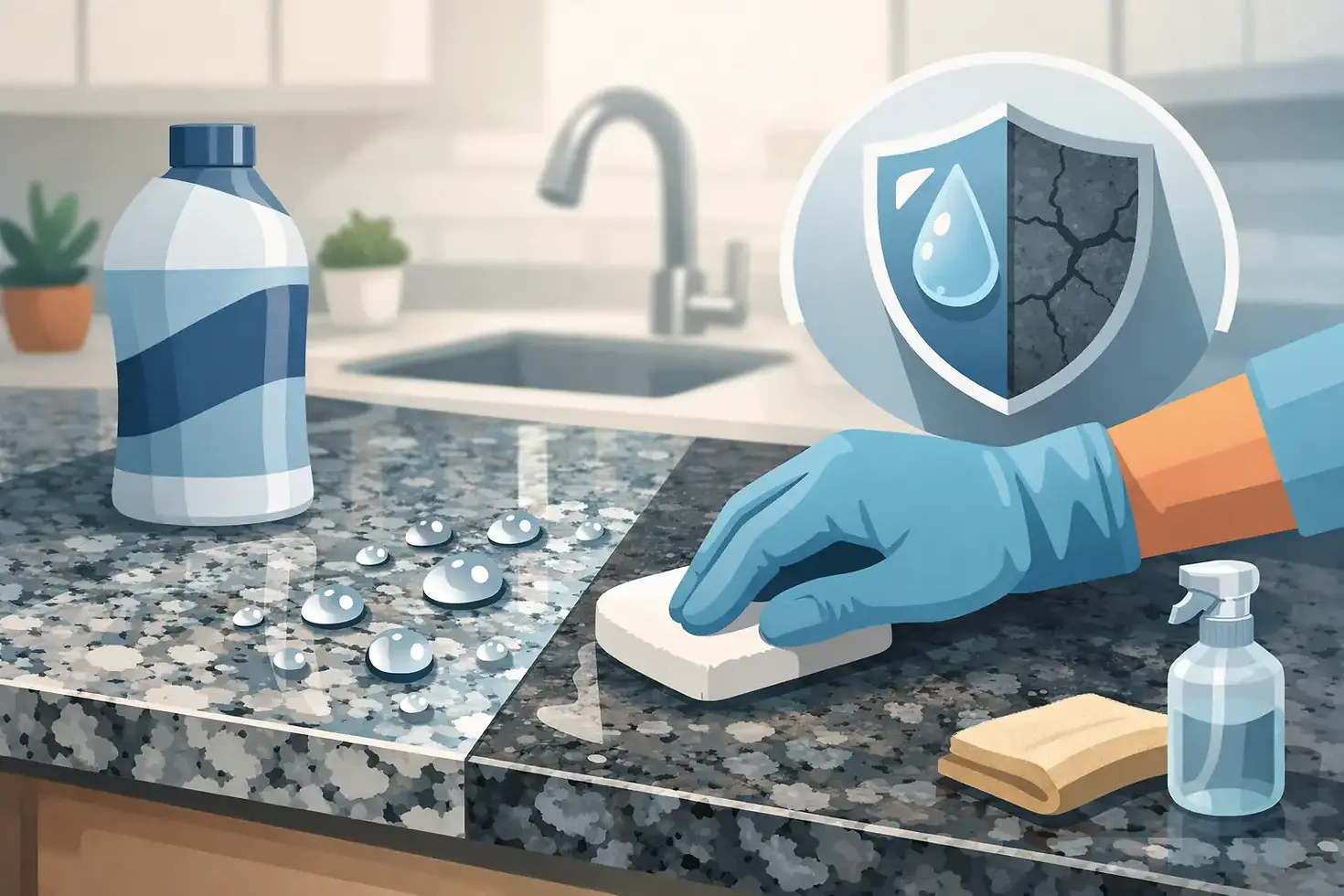
Before resealing, test the countertop. Choose a few inconspicuous but representative areas: beside the sink, near the cooktop, and a section used for food preparation. Place a few drops of clean water on the surface and leave them for 15 to 20 minutes.
If the water stays beaded on the surface and the granite beneath it does not darken, the sealer is still doing its job. Wipe the area dry and continue with normal care.
If the water begins to soak in or leaves a darker spot that disappears only after the stone dries, the granite is absorbing moisture. That is a good indication it is time to reseal. A countertop can still look shiny and pass the visual test while failing this absorption test, especially around high-use areas.
For a more complete check, repeat the test with a small drop of cooking oil in a discreet location. Oil travels differently than water and is responsible for many stubborn kitchen stains. Clean up the oil promptly after the test. If it darkens the granite or leaves a lingering shadow, professional guidance is worthwhile before applying a product yourself.
Signs Your Granite May Need Attention
Water absorption is the clearest signal, but several everyday clues can point to weakened protection. Watch for dark rings around glasses, darkening around the faucet, or spots that appear after spilled oil, dressing, or sauce. If liquids seem to disappear into the stone instead of sitting on top, the surface is due for a closer look.
Do not confuse sealing issues with every countertop problem. Dull patches can be residue from soap or cleaning products. White haze may be mineral buildup near the sink. Chips, open seams, cracks, and deep scratches require repair, not sealer. Granite is less prone to acid etching than marble, but harsh cleaners can still leave residues, weaken the sealer, and take away from a clean, polished appearance.
If a dark spot does not fade after the stone has fully dried, it may be a stain rather than simple water absorption. Applying sealer over a stain can lock in the problem. The right approach is to diagnose and remove the stain first, then protect the clean stone.
How to Seal Granite the Right Way
Sealing is straightforward when the countertop is clean, dry, and compatible with the product being used. The most common mistake is treating it like a spray-and-wipe countertop polish. A quality impregnating sealer needs enough contact time to enter the stone, and excess product must be buffed away completely.
Start by cleaning the granite with a stone-safe, pH-neutral cleaner. Do not use vinegar, lemon juice, bleach, abrasive powders, or general-purpose degreasers unless the product specifically says it is safe for natural stone. Remove all grease and residue, then allow the countertop to dry thoroughly. Moisture inside the stone can interfere with sealer absorption.
Apply the sealer according to its label directions, working in manageable sections. Keep the surface evenly wet for the specified dwell time, adding a little more product if dry areas appear. Then wipe and buff away every trace of excess sealer using clean, dry microfiber cloths. Any sealer left to dry on the surface can create streaks, haziness, or a tacky feel that is difficult to correct.
A second coat is not always better. Dense granite often will not accept much additional product, and overapplication can create more cleanup work without improving protection. Test the stone after the recommended cure time rather than assuming multiple coats are necessary.
Daily Habits That Help Sealer Last
The best way to extend the life of your sealer is to reduce what it has to fight. Wipe spills promptly, especially oil, red wine, coffee, tomato sauce, fruit juice, and dark-colored liquids. Use trivets for hot cookware and coasters for drinks, not because a sealer replaces good habits, but because repeated heat and moisture exposure can wear on any kitchen surface over time.
For routine cleaning, use a soft cloth and a pH-neutral stone cleaner. A small amount of mild dish soap followed by a clean-water wipe can work for occasional messes, but avoid making it the daily routine. Soap film can build up and make granite look cloudy or dull.
Never use the countertop as a cutting board. A knife can damage the blade and may leave marks on softer mineral areas or along seams. Keep abrasive scrub pads away from the stone, and avoid storing acidic or oily products where drips can sit unnoticed.
When Professional Stone Care Is the Better Call
Professional help is especially valuable when the countertop has uneven darkening, persistent stains, cloudy residue, damaged seams, chips, or questionable prior sealing. These issues can look similar from a distance, but each calls for a different treatment. The wrong cleaner or an unnecessary coat of sealer can make correction more difficult.
A trained stone specialist can determine whether your granite is actually absorbing moisture, whether a stain needs extraction, and which penetrating sealer suits the stone’s density and finish. This is particularly helpful for large kitchens, light-colored granite, commercial food-prep areas, and surfaces that have been treated with unknown products in the past.
For homeowners in the Pittsburgh area, The Rock Doc can assess the condition of granite surfaces and recommend a practical path to clean, protect, and restore them without guesswork.
Can granite be sealed too often?
Yes. Too much sealer, or sealer that is not fully buffed off, can leave a smeary, hazy, or sticky residue. Test first, then seal only when the stone shows a genuine need.
Does sealing make granite shiny?
No. Sealer is designed for protection, not shine. If granite has lost its visual clarity, the cause may be residue, wear, or a finish issue that requires professional cleaning or restoration.
Should new granite be sealed immediately?
Not necessarily. Test it first. Many new installations arrive with effective protection already in place, while some dense granites need little or no additional sealer at that time.
A well-cared-for granite countertop should make kitchen life easier, not more stressful. Check its protection once a year, act when the water test says it is time, and address stains or surface changes before they become a permanent part of the stone.


Comments